
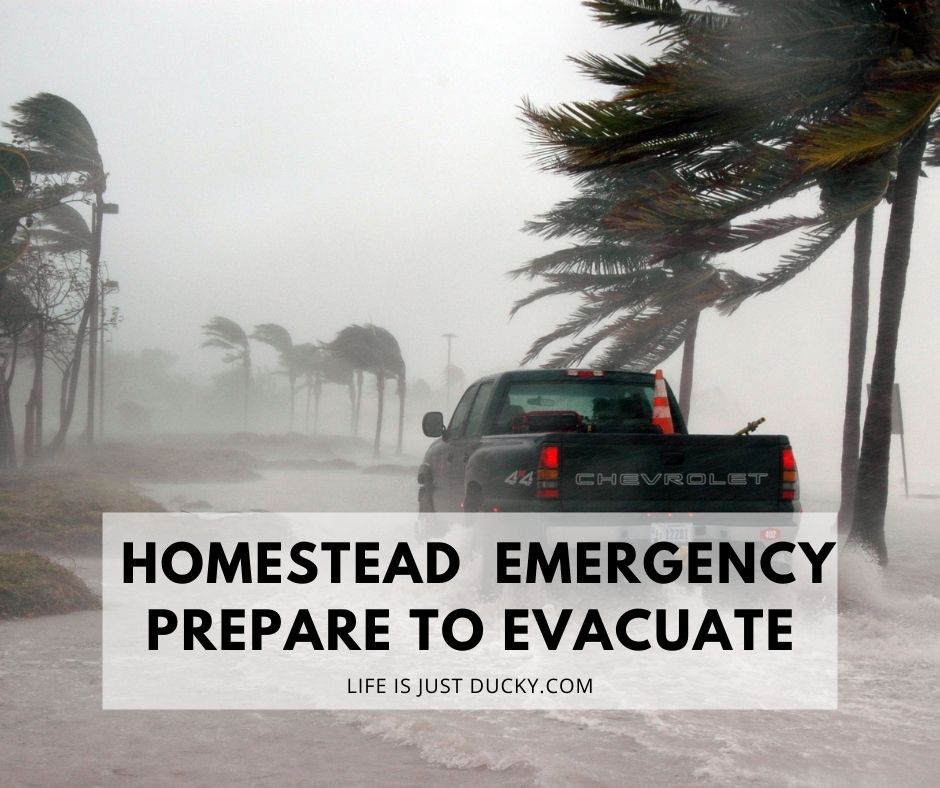
Every area has its disasters. What if a homestead emergency happened to you? We can’t turn our back on nature, even for a minute. What if you have to evacuate? As homesteaders, we have a responsibility to not just ourselves or even our families, but our animals too.

This post may contain affiliate links. I will be compensated if you make a purchase after clicking on my links. Please read my disclosure if you have questions.
Thank you for supporting this site with purchases made through links in this post. For Starters Here’s My Amazon Link.
Preparing For Homestead Emergencies And Evacuation.
I thought I was prepared for a Homestead Emergency, but I was wrong. I didn’t think anyone was more prepared for what my area had to throw at me. I even had one friend comment that “If we have a hurricane, I want to come to your house”. But with the arrival of hurricane Irma, I found that I had a few things left to learn. For one thing, I learned we can all be better prepared for what comes our way. Especially if you have to evacuate.
Whether your homestead emergency is a fire, a tornado, an earthquake, a flood, an ice storm, or a hurricane like mine was, the biggest thing I learned is you need to plan ahead. Your brain does not work well at the last second when your plans change. AND THEY CAN. You WILL forget things. I hope this article will help you think of things you may have overlooked in your plan and get things done ahead of time, so your next homestead emergency goes without a hitch.
A Disaster Preparedness Checklist.
- Write up an emergency plan
- Make connections ahead of time
- Train your animals for evacuation
- Stock up on supplies
- Check your supplies
- Have a go bag
- Know what you need if you have to evacuate
- What if you have to leave animals behind
1. Write up an emergency plan
No matter what your emergency is you need a plan and you need it on paper. For two very good reasons.
First, YOU may not be the one that has to follow them. You might be evacuating animals and someone else has to make other preparations. precious time is lost having to explain what your plan is.
Second, when you are stressed your brain does not work as well as it should and key details can be missed.
We were staying safely at home, or so we thought, then the hurricane changed directions. We had to evacuate at the last minute. In our rush, things were forgotten.
We have always ridden out hurricanes. In all the years we have lived in Florida, I have never felt the need to leave my house. But we haven’t had one like this since Hurricane Donna, which was before I was born. As the hurricane changed track and was heading straight towards us, they started talking about a 15 foot storm surge. That was more than I wanted to ride out. As the saying goes, Hide from the wind, Run from the water. So that is what we decided to do. Evacuate inland to a shelter. But what to do with our animals?

2. Make connections ahead of time
We all may be in a situation where we need to get out and evacuate our animals too. So where are you going to put them? Make connections ahead of time. Make it a priority to meet someone outside of your immediate area who has the place to put up your animals. Make it a reciprocal thing. They can bring their animals to your place if they need to evacuate and they will put up yours. Many people in northern California learned how important it was to have a place to take their animals to escape those horrible fires. Having this set up ahead of time will save much headache and worry.
Where can you find people like that? Check with associations you may have, Kiwanis, Rotary, 4H. Meet people through the mother earth news fair. Maybe it is someone you have corresponded with on Facebook for a long time. Maybe ask your friends or church members.
Another option is called a bug-out location. You might own this or share it with friends. A hunting or fishing camp or summer home is an example of this. Good for you if you have one. You are one step ahead. For the rest of us….
Remember to leave early as roads will get clogged quickly and you don’t want to get stuck on the road with animals and some kind of disaster coming at you.
Once you have a place to take them…
3. Train your animals for evacuation
Your wonderful docile goats will become raving lunatics when you are trying to heard them into a trailer they have never been in before. Make it a game with treats and practice, practice, practice. You will be so glad you did. Your animals can sense your stress and will be less cooperative. If they think this is something fun (or they get something yummy) they may be less likely to give you a hard time.
My daughter’s dog had never been off her property except to go to the vet. Having to put him in a cage at the shelter was traumatizing for him. (It didn’t do me much good either). A little training would have gone a long way.
|Related Post: Raising Ducks – 101 Duckling Care
4. Stock up on supplies
Remember, after a disaster, you may not have electricity or water for a while. Make sure you have things that are ready to eat and don’t need boiling water to prepare. You may have a period of time that you can’t cook anything.
Don’t plan on using candles because of the risk of fire. The emergency services are already overworked. You also may not be able to use that generator

Make sure you have a way to get your livestock water. A hand pump
If you are evacuating your animals don’t forget you will need to supply their food too. and any other supplies and needs they have. Don’t forget you need to have something to transport the food/hay in and something to hold water.
I also found a few things invaluable! My boots for trudging out through the brush and water. My headlamp

5. Check your supplies
Make sure your supplies are up to date. Some of the canned goods I had “for emergency purposes” were over 10 years old. I hadn’t done a very good job of rotating my emergency stock. (Just a note: MRE’s do go bad.)
Some of my batteries were less than fresh too. Check your supplies at least once a year at the beginning of your emergency season. Make sure you have plenty of water and a first aid kit too.
If you haven’t used your trailers in a while, make sure you check your tires regularly.
Another lesson I learned is to check all your emergency supplies, when you get them, to make sure they work. When we got to the shelter we got out our hand-crank radio and all we could get was static. My son-in-law had one too and his hand-crank radio
|Related Post: 10 Reasons To Raise Ducks!
6. Have A Go Bag
I don’t live in earthquake country. We have hurricanes, so I never saw the need to have a go-bag. We can see hurricanes coming for days. But this one turned at the last minute and we had to get out. Fast. Having to think quickly at the last minute was less than ideal. If you don’t keep the things in the bag, at least have a list of what you would put in it. Less chance for important things to be forgotten.
Your animals may need a go-bag (or list) too.
Don’t forget to pack something for entertainment. You can go stir-crazy with nothing to do. We had a ball with UNO


7. Know What You Need When You Evacuate
Your animals may be required to have certain shots. Even if those shots are not required at your home in your area, they may be required for you to take them to a shelter. They also may be required if you take your animal over state (or even county) lines. Check ahead of time to make sure.
Take along important papers. Shot records, Registrations, Host family’s contact information, accurate records of which animals went where. Make sure you leave your contact information with your host family too.
Make sure your animals are marked. Likely your dogs will be chipped. They may need a tag too. Make sure all your animals have positive identification on them. Whether it’s a brand, an ear tag, or a tattoo. You can mark unmarked animals and new babies with your phone number (including area code) using a livestock marking crayon
You need to have a way to transport all your animals. A trailer may seem like a luxury until a fire or flood is imminent.
Place contact information on your door when you leave. Leave a note saying that everyone is out so emergency personnel will not waste precious time checking on you.
If all your animals are evacuated, leave your gates open and your waterers filled for fleeing wildlife.
|Related Post: Deep Litter Duck And Chicken Run
8. If You Have To Leave Animals Behind.
Before this hurricane, we never even gave a thought to having a host family to take our family ducks and chickens to. But I didn’t want them to be spaghetti through the chain link of their run. I fed them well and left the run gate open when I left. I never expected to see the ducks and chickens again. When we got home they were all out of the run and way down the road. I figured they were gone, but I went in and filled the food container anyway and just left the door open. By nightfall, I went out and every one of them had come home. I just shut the door. Happy Mama.

Don’t chain or confine your animals where they will be trapped. Place them in a safe area (cleared for fire, cleared or an area with brush for hurricane protection). Fill all watering troughs and make sure they have enough food for at least 72 hours. Don’t rely on automatic waterers as you can lose power and they will stop working.
Even if they have an ear tag, make sure all of your animals are marked with a livestock marking crayon

Make sure farm equipment, trailers, and vehicles are undercover and/or on higher ground.
And don’t forget your neighbors. Check to see if they may need help too.
Planning For Homestead Emergency And Evacuation.
Each of our emergencies will be different. But all natural disasters require forethought and planning to ensure your safety and the safety of your animals. This is my attempt at starting you thinking about what you need to do in an actual emergency and the first step is to make a plan.
My prayer for each of you is that you never need to use your plan. But everyone needs to make one…Just in case.
Ok, What did I miss? I’m sure you probably have things you can add to this list. Leave me a comment below. And share this. It may help someone else out. Everyone needs to know how to prepare for an emergency evacuation.
Keep Learning
How To Get Rid Of Flies In Your Chicken Coop, Naturally!
A Well Designed Duck Coop To Make Your Life Easier.
All About Raising Alpacas For Fun and Profit.
10 Things To Know Before Your Start Beekeeping.
Raising Ducks 101 – How To Take Care Of Baby Ducklings.
Preparing For Predators On The Homestead.
Fast Ways To Get Rid Of Mice And Rats In Your Coop
Did you like this post? Then, I’d love it if you’d share it!
Want some more top posts? Check out this list of Reader’s Favorites.
Happy Backyard Homesteading!

I believe everyone can grow at least part of their own food! Let me show you how.

Mary is a gardener, backyard homesteader, and duck wrangler. She is also the owner and writer of LifeIsJustDucky.com and AGoodWordADay.com. (for daily devotions) Mary is passionate about helping others expand their backyard homesteading skills and learn to be more self-sufficient, no matter where they live.





http://Www.perelandra-Ltd.com has ETS emergency solution for both humans and one for animals for before, during and after traumatic events. (See their website for details). I have used their products for generations. When a neighbor’s meth lab made me deathly ill and lose my voice their products restored it in 5 days. The ENT doc said after 4 months that they could not fix it!
You can spend hours on their site. This is the real deal!
I already knew alot of this, but I also did not even think of a lot of this. I would be grateful either way, but I am exceptionally grateful for your work on this and sharing due to the many things I had not thought of. It just goes to prove how we all need each other in this life..sincerely thank you.
How sweet it is to say so. I do hope it helps people.