

Do you want a clean, healthy, easy to care for duck or chicken coop and run? Do you want fewer flies in the chicken run? Then let me tell you about the deep litter method.
This post may contain affiliate links. Please read my disclosure if you have questions.
Thank you for supporting this site with purchases made through links in this post. Here’s My Amazon Link
How I Started Out.
When my daughter first brought the ducklings home over ten years ago, we really knew nothing about raising ducks. After they had outgrown their brooder, she bought a chicken coop and a dog kennel for their run.
Related: What To Feed Ducklings.
They ate all the grass out of the site very quickly, and since I had heard about the sand method, and all our ground is sand here in Florida, I figured that was all we needed. Boy was I wrong! Very soon we were overrun with flies! My wonderful neighbors had no problem with us keeping the ducks, but they hadn’t agreed to a hoard of flies.
We tried about every type of fly trap there was, and while they helped, nothing could keep up with them. So I had to do something quickly. I did a little research and found The deep litter method.

What Is The Deep Litter Method?
The deep litter method is simply covering the floors and ground in the coop and run with the “litter” of your choice. Then as the chickens or ducks soil it, add another layer right on top. This keeps your birds out of their own waste, making a much cleaner and healthier environment. Then the lower layers compost right on the spot.
More Reading: Duck Eggs Vs. Chicken Eggs, Why Duck Eggs Are Better.
Why Use the Deep Litter Method?
Let me count the ways! (or the why’s in this case)
- Much easier and less time-consuming. You only have to scoop out the litter twice a year!
- It is cleaner & healthier.
- It doesn’t smell.
- It makes amazing compost.
- It attracts earthworms (in dirt floor areas) which help feed your birds naturally.
- It helps heat your chicken coop in winter.
- You get cleaner eggs (ducks drop them everywhere).
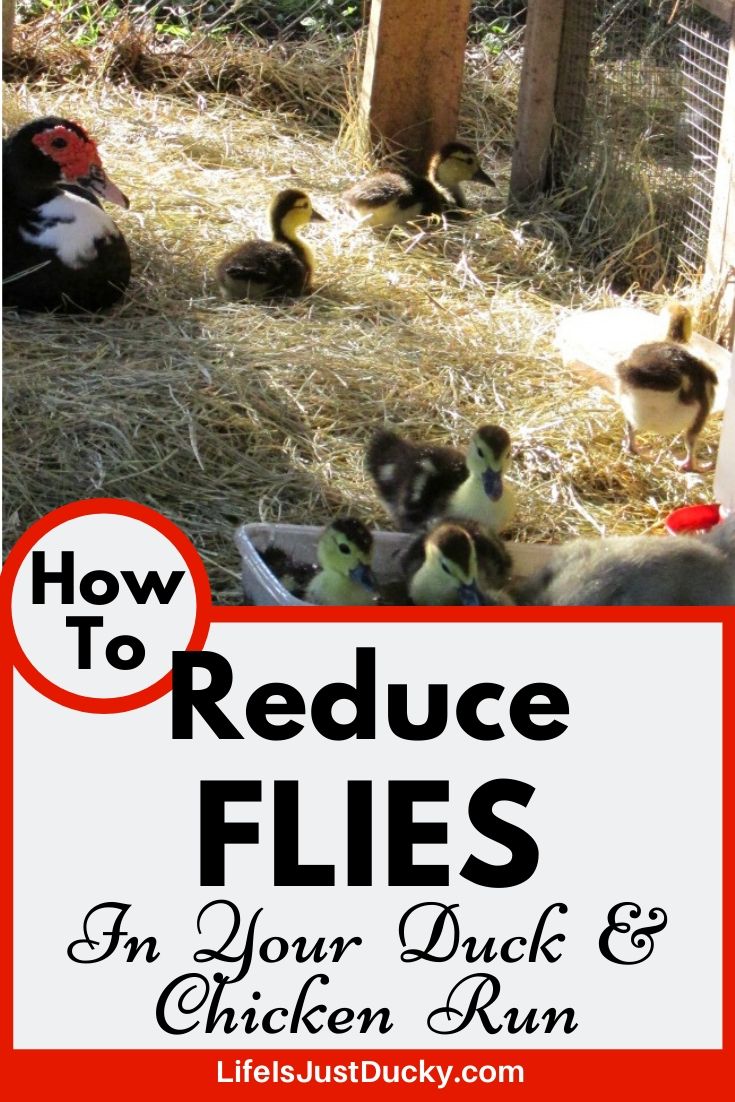
- It cuts WAY down on the flies!
What Do You Use For Litter?
- Pine shavings
- Shredded dry leaves
- Straw
- Shredded newspaper
- Dry/not moldy grass clippings
- Or my favorite – HAY
- DO NOT USE CEDAR SHAVINGS – They are toxic to fowl
Related: Preparing For Predators On The Homestead.
How Do You Start A Deep Litter?
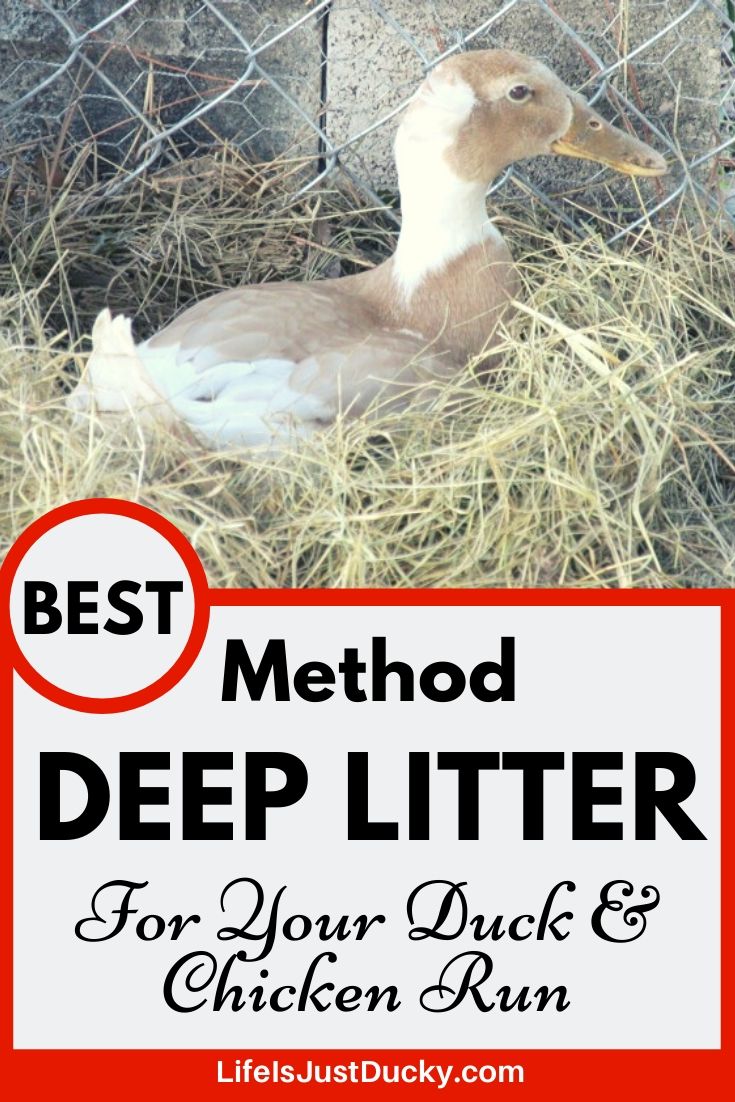
First, it is a good idea to do a thorough cleaning of your coop. Then add 2-4 inches of litter to all “floor” surfaces.
I just take handfuls of hay and shake it, until all the floor/ground is covered and looks new. Then when it gets soiled, I add another layer to it.
How long it takes to get soiled depends on how many birds you have and how big your area is. I have to add hay about once a week. While I was raising a batch of ducklings and had several extra birds in the same area, I had to put down hay about twice a week. In the rainy season, I have to add a layer more often too.
Related>> Build A Better Coop. Easy Coops Plans. (ad)
Some people like to turn their litter before adding new. Others will throw out scratch to get the chickens to turn it for them. My ducks dig for worms and bugs and do a great job of keeping it turned for me. If it begins to smell, you will want to turn/stir it, as getting air incorporated with it will speed up the decomposition and cut down on the ammonia.
As the litter and feces compost, the beneficial microbes multiply. This actually helps control pathogens and makes your flock healthier. Digging through the beneficial microbes is good for them, and helps them more easily fight off diseases such as coccidiosis.
What Do You Do With The Litter When You Clean It Out?
Oooohh, this is one of the best parts. While this deep litter is getting deeper and deeper it is making one of the best composts for your garden. In the spring when you clean it out you will want to add it to your compost pile.
The partially composted litter will really make your compost cook!
But in the fall, you can put it right on/in the garden beds as you are putting your garden to bed for the winter. Then your garden will be enriched with wonderful nutrients for your next growing season. (here in south Florida, I reverse that as our growing seasons are backwards)
Related: Do Ducks Need A Pond?

DepositPhoto ID# 27051067 @ andia-faith
Deep Litter Keeps Your Birds Warm In The Winter
As compost decomposes it puts off heat. This will raise the temperature in your coop by about 10 degrees. But you will need to make sure your coop is well ventilated. Chickens are especially prone to respiratory diseases.
Using the Deep Litter Method, your Chickens and Ducks will have a dry, fluffy, clean floor to enjoy. And it will provide some much-needed natural protein in the earthworms it attracts.
Related: Raising Ducks 101- How To Take Care of Baby Ducklings.
You will have a happier healthier flock. With a lot less maintenance, and far fewer flies. Plus wonderful compost! It’s a win-win all the way around.
Don’t your birds deserve the Deep Litter Method?
Another way to keep your coop cleaner is with the Automatic Treadle Feeder. It keeps mice out and reduces food waste. It’s a great addition to the deep litter in your coop and run.
Where there are chickens and ducks there will always be flies. The Deep Litter Method is wonderful, but I have a few more tricks up my sleeves too. Check out How To Get Rid Of Flies In Your Chicken Coop, Naturally! These are things that have really worked for me.
In between cleanings, if your coop starts to smell a bit…well like a coop, you can always sprinkle a bit of Sweet PDZ coop refresher. It is non-toxic, all-natural, and organic. You will love it!
Learn more about raising ducks and chickens check out:
Related: 30 Gift Ideas For Duck Lovers
Related: 10 Necessities To A Perfect Duck House.
Did you like this post? Then, I’d love it if you’d share it!
Want some more top posts? Check out this list of Readers Favorites.
Happy Gardening!

I believe everyone can grow at least part of their own food! Let me show you how.

Mary is a gardener, backyard homesteader, and duck wrangler. She is also the owner and writer of LifeIsJustDucky.com and AGoodWordADay.com. (for daily devotions) Mary is passionate about helping others expand their backyard homesteading skills and learn to be more self-sufficient, no matter where they live.



I tried deep litter with my ducks last year and the smell was unbearable once it got damp. Honestly, you’re better off just cleaning it out regularly unless you have an insane amount of ventilation.
Ventilation is VERY important, no matter what method you use. Second, how did your litter inside you coop get wet? Keep water out of your coop. That’s what a run is for. I hope you find something that works for you. I’ve been using it for over 12 years and I love it.
Do you cover your duck run? By that i mean, do you have a tarp or anything on the top or sides of the run so that the straw/hay isn’t getting rained on or wet?
I just rescued some ducks so this is alllll new to me and i thankfully came across your post about the ‘Deep Litter Method.’
I do cover the run…with welded wire to protect them from predators. As far as the sun, they do need somewhere to get out of the sun and rain. I had a small “covered porch” where their food was and where they could rest. They also had an oak tree that gave them shade for part of it and part of the run was in the sun, which they loved on cold mornings. Good luck with your new aquisistions!
Thank you for the deep litter method information! I was concerned whether I could use hay for the litter.
That is what I use because that is what is available in my area. Make sure whether you use straw or hay that no weed killer was used on it as that can kill your garden.
I am so glad I found your site! My husband I are new duck owners and had some questions about if we had them set up correctly. By reading your article, we now know we were doing the right thing but thought we had to clean the pen out every week. So we had a lot of duck litter to get rid of. Now we know to just keep piling it on. Thank you so very much! I will be referencing your site for other tips.
I’m so happy to help. If you are using organic material, you can compost the duck litter and use it to fertilize plants. Win Win.
I have read a lot about the benefits of using HEMP for deep litter for coops and runs. I have two pet ducks. Do you know anything about using deep litter hemp for coop flooring and ground cover for the open air run? I live in New Mexico, where winter nights are quite cold (below freezing) with day temps around 50 degrees and summer daytime temps averaging around 90 degrees. We do get some rain and snow but we are mostly in a dry climate. Thanks so much for your advice! I am a new duck owner. My young ducks are only five months old.
I know nothing about hemp. The big thing to be concerned with is does it get dusty. Things that get dusty can cause respiratory issues. Otherwise, I don’t know why it wouldn’t work. If you have a supply of it, give it a try. Just be prepared to pivot if it doesn’t work out.
This is fine method for an open-air duck run, but as a biologist, I recommend never doing this in an enclosed space like a coop. While it will produce heat as it decomposes, the waste of ducks and chickens is very high in ammonia and other nitrogenous products. In an enclosed space, this can cause burning and permanent damage to the birds’ respiratory system. So, by all means, layer it on in the run, but change the litter in the coop regularly!
All coops should have good ventilation for this reason, regardless of deep litter or not. Many poultry keepers use this method with very good result.
Just because you’re a biologist doesn’t mean you’re in any way a farmer. The deep litter method is used by many chicken keepers, in the coop, without a single issue. I personally know two people who have done it for many many years without a single issue whatsoever. This idea that everything needs to be cleaned and sanitized is actually what’s making us and our animals sicker!
I couldn’t agree with you more!
Hi Mary,
I’m curious if by layering the dirty hat would cause bacteria to fester underneath. Is their water source by the hay and if it gets wet often wont that cause bacteria to start growing? I know nothing about this. I’m awaiting our first ducks arrival and trying to learn more 🙂
I’ve never heard of anyone having a problem with bacteria. You shouldn’t have a water source inside the coop. In the run there is usually plenty of air circulation and sunshine to diminish bacteria. The only thing you might need to worry about is mold if it gets too wet. It gets sopping here in the rainy season and I just frequently add more hay on top. It works really well for me.
I live in SC and have a small coop and 4 rouen ducks. This is all new to me. They are almost 8 weeks old and I’m just starting this litter method. They have a small playground outside their coop. Where should I keep their food and water? Should their feed still be out all the time?
Also do I put hay in their coop and play area? I hope to eventually allow them out during the day.
Also my main reason for ducks are eggs. I have 3 males and a female and plan on adding a few more females. That’s a lot for a new duck owner. Any suggestions?
Thanks so much
Kim,
The first thing I want to address is you cannot have 3 males with 1 female. When they become sexually active, the 3 males will likely kill the female. The ratio has to be the opposite. I used hay in my duck’s coop and inclosed run and it worked very well, though every situation is different. I kept the water and food in the run area, but our area never freezes. You will have to keep that in mind for your winter. Many people feed twice a day, just the amount they will eat. I fed free choice and started having problems with rodents. Where ever you put it they will make a mess.:)
I hope this helps.
Thank you for the article. I really like that you live in the south, as different conditions require different approaches. Alabama weather is similar to Florida weather. Concerning the deep litter method, is your run covered to prevent the litter from being rained on? If so, do you think this would work in an uncovered run?
Marc, My “coop” is mostly open-air but is covered. But the run was open to the elements. It was no trouble during the dry season. (the occasional rain) But during the rainy season, (downpours every afternoon) I would need to add additional hay more often to keep it clean. I also had a bigger fly problem during the rainy season. But everything was much better with
the deep litter method than when I didn’t use it. Many people like to use straw and say it is better. If you do use straw make sure it is organic. Much of the straw now is sprayed with round-up. I don’t even use organic straw because it’s just not available here. We don’t grow grains in Florida, so I use what I can get. And I have had pretty good luck with hay.
Hello!
Our first 5 Khaki Campbell ducklings will arrive this week and I’m excited to be a first time duck momma! Your site it very helpful!
We live in Colorado and heard that this breed does particularly well in the winter.
Two questions:
1. Could you tell me about nighttime requirements during the brooding period? Will I be up frequently through the night, or will the ducklings be fine until morning if the temp is right and they have plenty of food and water?
2. When the ducks are living outside full time, do they need to have feed available 24/7, or could you schedule a daily time to have it available? No one has really addressed that, and it seems like that would be an easy way to minimize waste and predators!
Thank you! I’m sure I’ll have more questions in the future!
Laurel,
I’m so excited for you!!! No you do not need to get up in the night as long as the temperature is right and no predators can get to them. (thankfully) And no, many people will feed their ducks twice a day and that cuts down on rodents considerably. Let me know what else you need help with!
Educational
Wonderful! I’m glad you like it.
I am preparing my outdoor pen for my ducks and chickens . Currently the ground in that area is small rocks can I just put the hay right over that or do I need to rake out the rocks . I live in Phx where temps can get as high as 115 .
You absolutely can put the deep litter over the rocks. Just remember it may be harder to rake up the composted mulch without getting the rocks. Part of mine was over gravel that built up my duck pond. It was a bit more challenging in that area but worked. Congratulations on starting your duck and chicken journey!
Does anyone use sawdust as litter?
Deep litter method.
I would think that sawdust would be too dusty. Dusty things can cause respiratory issues.
Hi! I have two ducks open air run and a house as well. I live in Washington and I would love to do the deep litter method.
However, I don’t compost and don’t have a garden. What ways would you suggest I dispose of the bedding those two or more times a year? Thanks!!
If you don’t compost and don’t want to, The only solution is to bag and put in the trash or maybe donate it to someone who does compost. If you have too much to put in the trash at one time, take it out more often, or take out a portion at a time. (or start gardening!) 🙂
Ash,
Another thought. You can get a small composter and use the compost on your lawn or shrubs. (better than the trash)
I live in Oregon, where we have very wet winters. I’m using the deep bed method for my ducks, with straw in their house and their run. The run is open to the air and rain, enclosed with hardware cloth. During the dry summer the bedding was easy to fluff and I only added straw about once a week. Now that the rain has begun the straw is quite wet in their run and I have to add straw more often. I am wondering if I should put a cover over their run to keep the rain out and keep the bedding dry? There is plenty of air flow but I just learned about aspergillosis and want to keep a healthy environment for my girls. The girls don’t mind the rain in the run a bit and have hardly used their house at all so far. Thanks for the info!
Jason, Yes I know the rainy season is a pain no matter whether you have a deep bedding or bare ground. But I found deep bedding to be preferable where flies were concerned. You are not likely to have a mold problem when it is very wet. It is actually more likely when it is only slightly wet and then gets dusty. It’s when you fluff it that you should wear a mask.
What about oak shavings for the bedding? Does it matter what kind of wood shaving, other than cedar?
I don’t know of any other wood that is toxic. Wood needs to be dry to be absorbent. You can give it a try and see how it works. If I had a free supply I certanly would. Understand, it will not compost as quickly as straw or hay.
I’m a first time chicken owner, like the idea of the deep litter method idea. I’m nervous about having a heat lamp in the coop, such a small area. Do you do the litter in the coop itself as well or only in the run? Thinking ahead for winters here. Thank you!
I don’t actually have a coop, as I live in south Florida and don’t need it for warmth, but most people do the deep litter in the coop too. However, you must be very careful using an heat lamp with any type of bedding as it can start a fire. Make sure the lamp is kept far away from any litter. A heating plate is a safer option in an area where there is litter. Welcome to the poultry family.
Here is a link to a goat warmer that could easily be adapted for chickens or ducks.https://www.pinterest.com/pin/AenzK_djWrBSaG0IyGdBQZQfxCMjG_m2DSvAQLKzRFYKfy-GHzdP–A/
I live in northern Michigan where we have brutal winters. Last winter was my girls first winter. We did not use a heat lamp and they did fine.
As long as they have good ventilation and can get out of the weather, chickens and ducks can withstand quite low temperatures.
Can i use regular pine shavings like what comes packaged in walmart,usually used for hamsters?
Yes you can use the regular pine shaving from the store. I prefer using hay, only because it is the least expensive option in my area. I’m a big believer in using what you can get inexpensively. Enjoy the adventure!
You mention cleaning it out and putting it into your compost and/or garden. How often should you do this?
That all depends on your set up. I clean it out about 4 times a year. A lot of people clean it out in the spring after the long winter. The deep litter acts like insulation and helps heat the coop. I use it in the run too and I like to use it in the garden so I do it more often. There is no hard and fast rule for this, it is a matter of preference.
We are in South East coastal Georgia and are considering trying this. Do you know if pine straw would be a good litter? It’s readily available here, and less expensive than most the other options.
I have never used it or heard of anyone who has. That being said, I would think it would work, However, it might be a bit pokey and needles are not very absorbent. That’s the best I can offer on that. Sorry, I can’t be of more help.
Ive read somewhere in my research that pine scent is too strong and can harm their respiratory systems. I would make sure it is brown and well dried out to be safe. I am still learning so could be wrong.
I’ve never heard of anyone having a problem with pine. But all coops should have good ventilation.
I’m dying to try this deep litter method but will the composting in place during the summer months increase the already too high temp?
I live in Florida with an open pen. The weather is already too hot! I don’t know how it will affect a closed up coop. You should provide plenty of ventilation either way.
we live in Indiana andnhave 14 chicken this would not work for use to much snow and rain but thanks
Many people find this works very well in the duck or chicken coop in the winter. It can help insulate and keep them warm and clean in the winter. Also putting hay or straw on top of the snow on sunny days allows the birds to get outside without wading through the snow.
Thank you for posting this! We just tried this with hay and it’s only been a little over a week but it has already made a world of difference!
It really changed my world. I’m so glad it helped you too.
Hi…thanks so much for the deep litter info. I was just curious since we have ducks as well and they tend to soak the bedding, doing the deep litter method won’t it get moldy? All suggestions greatly appreciated. 🙂
Tiffany,
Thanks for stopping by. I live in very rainy Florida and I have never had a problem with mold. Everything in my run IS open to the air. I do not shut them up in a coop. They are enclosed by a run and can go in and out of the coop as they wish. The hay gets VERY wet in the summer and around the pond all year, But I’ve never had mold in the hay. In the food they eat…. that’s another story. I’ve had to dump a bunch of that that did not get eaten. Sometimes it’s hard to judge how much they are going to eat.
A suggestion, I just put their food on ground,hay actually and let them pick and scratch. I started them using a bowl or pan and they kept roosting and pooping and as I watched them, i saw they preferred scratching and picking. Due to my location they stay in coop,has runs on both sides so they get sun and fresh air. Ive never had their food mold , but then i only feed them once a day and they peck and scratch for bugs and worms. I used to feed them twice a day but they didnt eat half of what i gave them so cut down on the waste.
A bowl on the ground doesn’t work well. I have a feeder that I hang so they can’t perch on it and poo into it.
I live in Queensland Australia. We have hot wet summers and dry cold winters. I have 22 ducks and 23 chickens and 7 guinea fowl. They roost in separate pens at night and free range by day. I have a hanging feeder for the ducks. I have a T (upside down) shaped feeder for the chickens. It has a wide slot in the top of the cross bar and eat from there. I have no waste as it is at their chest height. I am using drinking cups for their water and am going to use the slightly larger cups for the ducks at night. I have a problem with the ducks making the coup too wet with ground level drinking pans. The cups are fed by a water drum and a clear hose which allows the water to flow as needed as it is gravity fed. I don’t have any poop in the water or food.
Wow! It sounds like you have it all figured out. It sounds like a very good system. Congrats! I’d love to see photos. Mary@lifeisjustducky.com.